The Differences between Nylon Line, PE Line and Carbon Line. Fishing enthusiasts often wonder: Which is better, nylon line, PE line or carbon line? It should be known that the fishing line is an important component that directly connects the angler and the fish. The choice of fishing line is closely related to the fishing effect.
What is Nylon Line
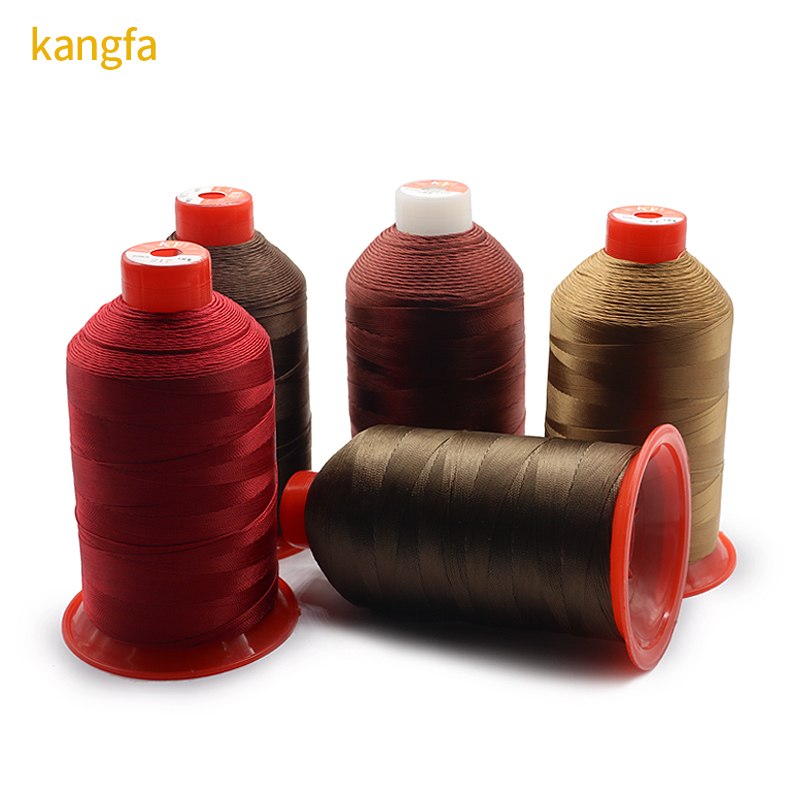
Nylon line is made by twisting nylon material yarns. The produced line has a certain tensile force, strong pulling force, is shiny, resistant to high temperatures and high speeds. It is mainly suitable for sewing leather products, such as in the shoe industry, bag industry, sofa industry, etc. Nylon line is the most commonly used leather sewing line. Meanwhile, nylon line is also a commonly used line for fishing rods.
Nylon line is also the most frequently used line in Taiwan-style fishing. The chemical raw material of nylon is PA, which, like PE, is a downstream product of petroleum. Different from PE, nylon line is usually a single-strand line, and the characteristics of this line are just the opposite of those of PE line. The advantages of nylon line are that due to its certain ductility, it is not easy to break when casting and when a fish bites. Since the production technology has developed for nearly 70 years, it has a low cost and a large output, and is much cheaper than PE line. Finally, the surface of nylon is smooth, which can minimize the wear on the line guides.
Ductility is also a disadvantage of nylon line. In some situations where the fish bite signal is weak, nylon line cannot convey the signal of a fish biting to the angler in time, thus losing the best opportunity to lift the fishing rod. In addition, under the same pulling force, the diameter of nylon line is thicker than that of PE line, which affects the casting distance of lure fishing.
What is PE Line
It refers to a fishing line made by braiding multiple strands of chemical fibers and then impregnating them with glue, commonly known as braided line (BRAIDED OR CORD LINE). The earliest one seen was "Dai Li Ma".
The production method of this fishing line is: multiple fine fibers (such as Dacron fibers, Kung Fu Long fibers or Dai Li Ma fibers or other PE fibers of polyethylene compounds... etc.) are braided by machines. Therefore, the line body of this fishing line presents a pattern of regularly crossed fibers. As long as you take out the line body and examine it, you can clearly find the characteristics of its line body structure.
The advantages of this line are that under the same pulling force, the diameter of the line is much thinner than that of nylon. Similarly, if we use 12-pound nylon and 12-pound PE, because the diameter of PE is thinner, it can be cast farther. In actual fishing grounds, wind force is an important factor affecting the casting distance of lure fishing. PE also has the characteristic that under the same pulling force, the diameter of the line is thinner, which can reduce the influence of wind resistance. Besides, PE has almost no ductility and can convey the signal of a fish biting to the angler in the first instance. Also, PE line is more wear-resistant.
But just like everything has two sides, PE is not without any disadvantages. The first disadvantage of PE is that it has no ductility. This characteristic can quickly convey the signal of a fish biting to the angler, but it also often leads to fish getting away or "shooting" (when the line breaks during casting). Friends who have played Taiwan-style fishing know that after a fish bites, a certain force should be maintained on the fishing rod so that the fish is not easy to get off the hook. A soft rod is not easy to break the line and let the fish get away, but it takes longer to land the fish; a hard rod lands the fish quickly, but it is easy to break the line and let the fish get away. Similarly, you can regard the line as an extension of the rod. If the fishing line has a certain ductility, it is like a relatively soft rod, which can ensure that a certain force is always maintained when the fish swims around. And PE is like a relatively hard rod, with less room for playing the fish, which leads to the fish getting off the hook or the line breaking. In addition, in order to use a thinner line diameter to achieve stronger pulling force, some manufacturers add metal wires to PE. Although the pulling force is strengthened, the ductility and softness of the line are further reduced, and it is also easy to wear the line guides.
What is Carbon Line
Carbon line is made by drawing resin containing fluorine and carbon components. The characteristics of carbon line are high specific gravity, fast water cutting, extremely low refractive index of light (almost invisible), no water absorption, and much stronger resistance to ultraviolet rays and durability than nylon line. Because the physical characteristics of carbon line are very low ductility and high specific gravity, it can make the bait reach the required water layer quickly. And because of its very low ductility, it also provides good sensitivity. Because the refractive index of light for carbon line is almost 0, it will reduce the sensitivity of fish, allowing fish to take the bait into their mouths without worry. Carbon line is suitable for use with soft bait fishing rigs, such as lead-free fishing rigs, WACKY, Texas fishing rigs. It is not very suitable for use with hard baits or surface lures. However, carbon line is not without disadvantages. The knot strength of carbon line is relatively weak and it is relatively hard. If it is used as the main line, it is recommended that the main line used on a spinning reel should not exceed 10 pounds, and for a baitcasting reel or a drum reel, if there is a special need, it is best not to exceed 20 pounds. Carbon line can also be used as a leader line. Because carbon line is more wear-resistant, it can be paired with PE line to make up for the shortcoming that PE is not wear-resistant.